

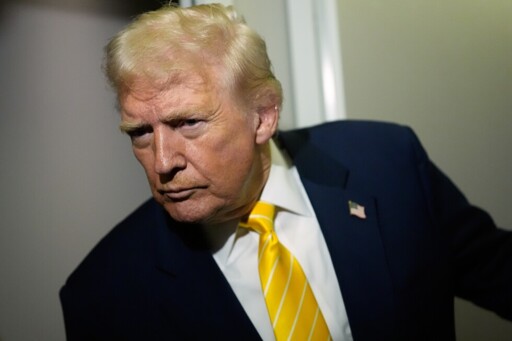
Donald Trump announced Friday that he was scrapping U.S. tariffs on beef, coffee, tropical fruits and a broad swath of other commodities — a dramatic move that comes amid mounting pressure on his administration to better combat high consumer prices.
Trump has built his second term around imposing steep levies on goods imported into the U.S. in hopes of encouraging domestic production and lifting the U.S. economy. His abrupt retreat from his signature tariff policy on so many staples key to the American diet is significant, and it comes after voters in off-year elections this month cited economic concerns as their top issue, resulting in big wins for Democrats in Virginia, New Jersey and other key races around the country.
I mean, let’s just sit back and observe the stupidly obvious fact that Trump is lowering tariffs to lower grocery store prices, which necessarily confirms Trump knows that creating tariffs raised the grocery store prices, despite that he has said the exact opposite.
So tell me, mainstream media: Did we do it? Did we catch Trump in a lie so logically incontestable that your reporters would feel empowered to finally report it as a “lie”?
[Scans article]
…sigh.
They can’t say ‘lie.’ It’s one of the few words you can basically never use as a journalist.
It’s not about the incontestability of the truth. It’s about the fact that a ‘lie’ (as opposed to a ‘falsehood’) requires intent. Basically, unless you have psychic powers, or a written, signed declaration from the person saying “Yes, I intentionally lied,” you can’t prove it’s a lie. And in journalism, you do have to be able to prove the things you say. Potentially in a court of law.
He could just be stupid. He could just be ignorant. He could just be suffering from serious mental decline. We don’t know for sure.
I get that’s not a satisfying answer. We all know, intuitively, that Trump lies, constantly and endlessly. He tells himself ten lies in the morning just to get out of bed. I get it. We all know it. But journalism has to be held to a higher standard, and that standard has to be applied consistently, not just when it suits us.
Yes, all well and good, and upvoted for the rational response of course.
I understand there are standards. But the enemy of the good is the perfect, and if journalistic standards require perfect evidence and won’t otherwise represent the best-fit explanation, then they are easily exploited by bad actors like Trump who will intentionally withhold perfect evidence. The public good is served by reporting from a reasonable person’s perspective what the most likely explanation is, including the terminology that goes with it. Here, that is a “lie.”
I’d also argue their concern in this case isn’t standards, but legal liability for defamation. At least from a legal perspective, reporters and publications have clear defenses at this point to saying “lie” since regardless of subjective momentary intent, the preponderance of people / jurors should accept contextual evidence of intent like his prior statements.
And even journalistic standards should be addressable by calling it something like an “apparent” lie to allow the possibility of other explanations, while still calling it what it almost certainly is.
