

This should be excellent for selfhosters that have all their services in one VM. I haven’t tried this myself, but I think this means you can:
- you can create memorable links instead of memorizing port numbers:
jellyfin.foo-bar.ts.net - share one service from a machine instead of all of them in a more intuitive way
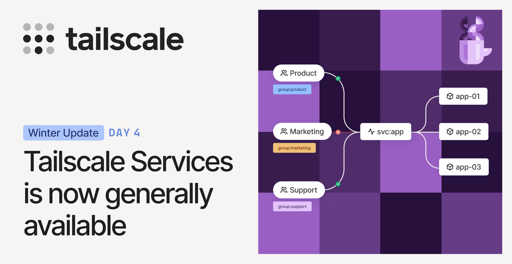
If you’re new to Tailscale Services, it lets you publish internal resources like databases, APIs, and web servers as named services in your tailnet, using stable MagicDNS names. Rather than connecting to individual machines, teams connect to logical services that automatically route traffic to healthy, available backends across your infrastructure. This decoupling makes migrations, scaling, and high availability far easier, without reconfiguring clients, rewriting access policies, or standing up load balancers. Our documentation has details on use cases, requirements, and implementation.
While this is great, especially for smaller self-hosters, as a setup gets more and more dependent on Tailscale, one should think about self-hosting Headscale, and therefore not being over-reliant on services not offered by it. I’m in that boat and I haven’t done the Headscale migration yet.
Yeah it’s gonna hurt a lot when they enshittify
What is it about Tailscale that is giving you heartburn? I am over reliant on my ISP. Without them, selfhosting would be rather bland.
Ownership, size and profit growth strategy. My ISP is a massively profitable poorly regulated oligopoly. The deal there is clear - they’re already charging as much as the market can afford. They aren’t providing a free service today that they’ll have to monetize down the line to compensate for the time operating on VC funding. Tailscale, awesome as it is today, is in my view guaranteed to enshittify over time as they start getting pressed to grow profit. That’s not too much of a problem for me since the clients I use are open source and there’s an alternative open source server. If I used features unavailable in Headscale or were in over my head and unable to self-host Headscale, I might be in a bad time some time down the line.
Would it make you feel better if you paid Tailscale for one of their plans? It’s not like they are just giving away their whole enterprise. It’s fairly trivial for them to give free services, kind of like Cloudflare, Oracle, et al. Reading a bit reveals:
- Tailscale’s estimated annual revenue is currently $45.2M per year.
- Tailscale’s estimated revenue per employee is $230,489
- Tailscale’s total funding is $277M.
- Tailscale’s current valuation is $1.5B. (April 2025)
- Tailscale has 196 Employees.
- Tailscale grew their employee count by 23% last year.
That seems pretty profitable. Enshitification happens. It’s been going on since I was born. If it’s free on the internet, and later it becomes a paid service, then I just find something else that fits. Or pony up the cheapest plan they have, which currently is their Personal Plus @ $5 USD per month. I don’t mind paying for a good service and $5 USD is burger from McDonalds. Extremely well under what most people put into a hobby. Will prices increase? Maybe…everything goes up. Rarely do services and utilities go down in price. When the price points are no longer justifiable, again, I look for something else that fits.
Enshitification happens.
I don’t think that’s a given necessarily, I think it’s a common pattern under the vc funding -> IPO model.
But companies like Steam and Patagonia show that companies don’t all have to follow the same predictable enshittification arc.
There’s also Netbird, worth checking out.
Netbird and Pangolin too.
I did it about 8 months ago… it just works like black magic. It’s a “fire and forget” VPN, but SSO is a must in my opinion; otherwise, key exchange is too tedious.
You’re talking about Headscale right?
Yes… sry wasn’t clear about that…
Can you share what components are you using for SSO, UI, etc.?
Never got warm with all the UIs available. But things change very fast on that front. For me it looks like that they only differ by the time it takes to provide support for the newest headscale version. Just take the one supporting yours :) For SSO , the OIDC provider from Nextcloud is working as good as any other. Having some kind of static IP also helps but the headscale server runs on HTTPS port plus some optional ones (not sure if I remember correctly) dynamic dns should be ok as well.
Not OP but I use headscale and have it configured using Authentik for SSO. Works flawlessly once its up and running. I also use headplane for the UI. It has SSO integration as well which makes everything a breeze.
Edit: Forgot to mention, all running in docker with traefik as the reverse proxy.
I switched to pangolin and I am amazed how well it works.
Love pangolin. Although I wish internal connections would make more sense
I have long had a switch to pangolin for my homelab services on the roadmap. Can you explain what you mean with internal connections making more sense?
- you can create memorable links instead of memorizing port numbers:
jellyfin.foo-bar.ts.net
BTW, I’m doing something similar with standard DNS records that point to an internal Tailscale IP. I can go to https://immich.mydomain.com/ which only works if Tailscale is active. Let’s Encrypt works too. Obviously the setup isn’t automatic but it’s automateable for more adept self-hosters.
Immich needs this, right? I remember it not working on a tailscale funnel path.
I haven’t tried funnel but it works using an internal Talscale IP/host and port. E.g. http://the-immich-host:1234/ if the-immich-host is a Tailscale machine.
I do this too. Can recommend.
Does this work from outside your lan or just when you’re in the network with your dns server?
Works outside. I’m setting a standard DNS record on a standard DNS provider to an internal TS IP. The record works everywhere but the IP is only accessible when TS is on. Whether I’m on the local net or outside.
- you can create memorable links instead of memorizing port numbers:
Acronyms, initialisms, abbreviations, contractions, and other phrases which expand to something larger, that I’ve seen in this thread:
Fewer Letters More Letters DNS Domain Name Service/System HTTP Hypertext Transfer Protocol, the Web HTTPS HTTP over SSL IP Internet Protocol SSL Secure Sockets Layer, for transparent encryption SSO Single Sign-On VPN Virtual Private Network
[Thread #106 for this comm, first seen 20th Feb 2026, 18:41] [FAQ] [Full list] [Contact] [Source code]