

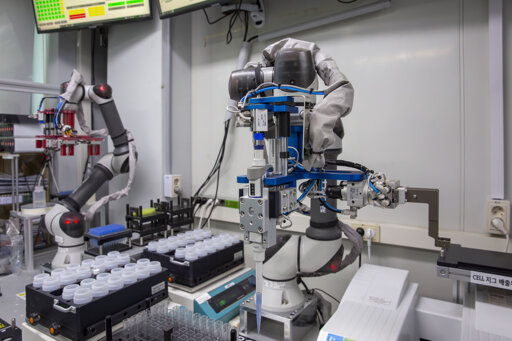
Developing new catalysts requires large-scale, repetitive experiments with frequent changes to catalyst composition and reaction conditions. Manual experiments are time-consuming and error prone. A team has automated this process and significantly increased reproducibility by employing robots to manage reagent compositions and run the repeated tests.
This is proper use of robots. Repetitive work that is error-prone for humans to do.
Also, notice the robot is not in a human form, because it doesn’t need all of that overhead. Imagine Elon showing up with one of his robots…
“Why are you trying to sell me a machine that can dance the Charleston and do backflips? I don’t need that capability and I don’t want to pay for it. I don’t even need a robot that can roll, let alone walk and dance.”
The majority of work that can be done by simple arm robots has been replaced with simple arm robots.
The humanoid robots are not going to fulfill that niche.
IMHO you’re right. Most people don’t know that “one arm robot” do exists and can be programmed to do a lot of stuff with great precision (some up to almost a micrometer/nanometer). They already have eyes (precise cameras on the side of the robot) and don’t need legs or torsos because they don’t need to move.
Then what niche will they fulfill? What work requires a humanoid form?
All the work done by humans right now.
Tends to be either stuff that is difficult to automate or work that is so short as to not be cost effective to buy a robot that only does that one job.
Humans aren’t good at doing most thing. But they are very very good at doing a lot of things.
Flexibility is the main thing that employs people in factories right now.
I have to disagree with that. Most positions in factory jobs exist because human labour is very cheap, especially in terms of flexibility. I doubt there are many positions where a robot with a less humanoid shape wouldn’t do a better job than a human or a humanoid robot. It’s just often cheaper to employ these workers because you pay them a salary, either on a hourly basis or on a monthly one, yet don’t have to worry about maintenance. With robots you have less hourly costs, but a much bigger overhead, as you now have to hire qualified technicians to perform regular maintenance on those machines, and also semi-regularly order replacement parts. These costs will rise alongside the complexity of these robots. And humanoid robots are much, much more complex than industrial robots, especially as they need to incorporate a lot more sensors that most industrial robots just won’t need. Sensors that might be very sensitive or require regular calibrations to ensure they work properly. That doesn’t come cheap.
Even when we look over the costs, humans will always be more versatile than robots. Give a person a book on how to do a job and they will perform it with the help of the books, and develop their working style to even work more efficiently. In contrast, robots would need a much more thorough training in order to work properly. This could be done traditionally by hardcoding the logic, or by using neural networks, which would be more intuitive, but are prone to create undesired results if one doesn’t have a good eye for the involved factors. And this process would need to be repeated for each job, and again if jobs would be fused together. And of course one would have to adhere for hardware limitations. A processor can only work so fast, and there are limitations on storage space, data transfer speed and reliability that also come to play when it comes to saving the training data.
It seems to me we agree on everything except scale.
You don’t see humanoid robots being good enough and cheap enough to replace humans in any job. I do. I think it will start slow and progress overtime. Same how robotic arms started slow and then reaching more factories and more types of work.
The price people are saying these robots will cost is way less that what it costs to keep humans around.
The reason a humanoid robot will be used over a robotic arm is the same reason humans are used over a robotic arm that’s flexibility. The reason a humanoid robot will be used over a human is cost.
Yay, more lost jobs for humans!
Admittedly, we were not very good at this particular job.
yeah this is a bit like the automating of mapping the genome which was a good thing.
They’re only catalyzing and speeding up the demise of humans. Thanks for supporting the cause, cuz who needs humans anyways when the robots take over everything?..
I hate AI as it is, but those robots can have precision up to a few nanometers, which humans will never be able to do. Those machines are not replacing anything here.
Honestly its not like were doing the greatest job rn, why not let the clankers have a run
I for one am looking forward to the robit takeover. I think the world will probably become a safer and more pleasant place overall. Maybe there will even be some humans left over for zoo exhibits for robit entertainment.
It’s just scut work, and needs direction from humans
Software engineering has already gone through a similar transformation where we expect all the builds, scans, tests to be automated, the scut work done by “robots”. That resulted in new job types, DevOps engineers, and the software field has continued to grow. While it remains to be seen how ai will affect the field, automating the scut work allowed the humans to be more productive, the field to continue growing, software to be better quality


