People doing something in your immediate vicinity, without excluding you or in other ways hinting you have to do the same, are not peer pressuring you. Any obligations you feel to do the thing is entirely caused by your own insecurities.
Well, there is an innate drive to be part of a community baked into our biology. We see people enjoying something, and we want to do it too. It doesn’t need to be framed so negatively as being an insecurity, though I wouldn’t necessarily frame it as peer pressure, either. It’s more just a human desire to share in a new experience with others.
Peer pressure is the sensation of psychological pressure when deviating from peers. It doesn’t have to be caused intentionally or through active action, and it’s a basic fact of life that at least 95% of humanity experiences. (I can’t speak for all forms of neurodiversity).
Ok let me rephrase it a little more clearly. There’s external peer pressure, and internal peer pressure. What I described in my other comment is a lack of external peer pressure from your surroundings, and your internal peer pressure compelling you to do something. Internal peer pressure is a problem caused by yourself, and you cannot blame that on anyone else.
Susceptibility to both what you describe as external or internal peer pressure always comes down to your own insecurities.
For example, I don’t drink alcohol and I don’t smoke. Never did. Growing up there was quite a bit of external peer pressure. But I still decided to not drink or smoke and I stuck to it. Your actions are your actions, and you can’t blame anyone for them no matter if it’s external or internal peer pressure.
But the whole premise is flawed. Having to “blame” someone for your own decisions is always a sign of not exactly being in control of yourself and your life. It’s always a sign of not being exactly mentally fit. Because this action in itself is a sign that you don’t take responsibility for your own actions, but instead look for someone else to blame your decision on.
I don’t see OOP doing that in the cartoon. She takes responsibility for her own actions. “I peer pressured myself”. She realized the mechanism at play (she wanted to fit in, and thus did something she actually didn’t want to do) and took responsibility for it. She’s not looking for blame anywhere at all.
But the whole premise is flawed. Having to “blame” someone for your own decisions is always a sign of not exactly being in control of yourself and your life. It’s always a sign of not being exactly mentally fit. Because this action in itself is a sign that you don’t take responsibility for your own actions, but instead look for someone else to blame your decision on.
I would argue that children and teenagers are generally susceptible to this while being perfectly developmentally healthy (though of course, not fully mature). It’s great that you weren’t susceptible to those pressures, but many others are at those ages, and that’s not indicative of any mental weakness. Susceptibility to peer pressure is a helpfully adaptive trait in many ways (it goes a long way towards making people generally more hygienic and friendly, for example), it’s just value neutral for people who aren’t yet good at predicting the long-term consequences of their decisions.
I don’t see OOP doing that in the cartoon. She takes responsibility for her own actions. “I peer pressured myself”. She realized the mechanism at play (she wanted to fit in, and thus did something she actually didn’t want to do) and took responsibility for it. She’s not looking for blame anywhere at all.
In the cartoon, no, but the OP of this thread phrased it a little more actively. I don’t have a problem with it and think it was chosen for comic effect (successfully, imo), but I think that’s what your parent commenter was responding to.
The daughter references the mother visiting her, indicating she is living alone. That’s a somewhat decent indicator for adulthood, at least in most cultures.
lmao… my first instinct was to type it out, i figured people shorten it as a sort of trauma filter, knew at least one person would think it was “Erectile Dysfunction” but proceeded nontheless
IDK if there’s a similar function on Lemmy, but at least on tumblr it’s recommended to tag things in full (eg: a post about eating disorders should be tagged eating disorder instead of ED or funky eating or something dumb like that) so that way filtering is easier (though, people who don’t want to see ED content would likely filter both, it’s good for when there isn’t a specific euphemism everyone uses (there are so many terms people use for rape on the internet it isn’t even funny))
There are coffee withdrawals? I drink 2 (weak) coffees a day sometimes 3 and I have multiple times had a week or two without coffee because I forgot. I just drink it for the taste and warmth.
It’s caffeine withdrawal. I used to get it a lot as a kid. My parents were separated and one of them had caffeinated drinks and one didn’t. When I figured out why I was getting headaches, I just stopped drinking anything with caffeine.
My dad is an alcoholic and I’m convinced that I’ve inherited certain vulnerabilities to addiction. I’ve never had a problem with alcohol, but by God, when I get into a regular full-caf coffee habit, and then I miss one or two cups, the withdrawal symptoms hit me hard. I’ve been trying to slowly lower my ratio, but it’s hard to even contemplate going totally decaf when I’ve got a retail job and I’m a little scared of trying to deal with customers and withdrawal headaches at the same time.
The way caffeine works is that it allows the body to release energy reserves that it usually “locks” away from you. It allows you to tap into these reserves for concentration and makes you feel less tired.
That’s helpful for short-term use, giving you more energy and concentration.
But if you use too much caffeine for too long (“too much” depends on your body and “too long” is a few days), the body adjusts to the caffeine levels and now you have the same energy reserves and concentration that you had without caffeine before. Caffeine thus loses its effect on you and your baseline shifts, so that you need caffeine to be on the same level as before.
If you now stop your caffeine intake, this swings back. Your body thinks you are really tired and you get headaches, bad mood, low concentration and so on, until you either take in more caffeine or you abstain long enough for your baseline to shift back.
That’s why there are people who say they can’t work before they had their first coffee/energy drink. They literally can’t, because if they aren’t on the level of caffeine they are used to, their body tells them that they are super exhausted. This is the caffeine dependency/withdrawal effect.
When you wake up your body starts producing adenosine, which slowly locks into receptors in your brain. As the day goes on, these receptors fill. By the end of the day your receptors are full which tells you you’re tired and need to go to sleep. When you sleep, these receptors clear to start the next day fresh (which is one of the reasons if you don’t sleep well, they don’t all clear and you start the day tired.)
Caffeine fits these receptor sites, preventing the adenosine from locking in and delaying the onset of fatigue. Caffeine half life is about 5-6 hours, which can lead to the “crash” as the free adenosine starts locking into the receptors the caffeine is now making available as it breaks down.
When caffeine is consumed regularly and the brain isn’t detecting the expected adenosine feedback, it responds by creating more receptors. More caffeine is now needed to account for the new receptors. If you skip caffeine with the addition of receptors, the adenosine fills the extra receptors faster and leaves you comparitively more fatigued/with withdrawal symptoms. If you reduce/abstain from caffeine for a few days the extra receptors are reduced and you return to baseline.
That’s basically the same thing. When you feel sleepy, you aren’t at the end of your reserves. Your body tells you that you are sleepy at a time when you still have reserves.
Blocking these receptors doesn’t tap into any magic hidden energy, it just stops your body from telling you that you are running on fumes. Thus it allows you to go farther into your reserves. In extreme cases to the point where you collapse, because you really don’t have any reserves left.
Edit: Just to be clear, going into your reserves is not a good or healthy thing. It’s not some magical potential unlocker or something, but it’s running your body under circumstances it’s not made for. If you use caffeine when you really should be sleeping, that’s short-term ok, but can lead to some serious consequences in the long term.
But getting peer pressured into an addiction by one’s mom of all people is ironic.
It’s one case where I’d argue that the most literal interpretation should apply, dictionary definition be damned. Your authority figures are not your peers.


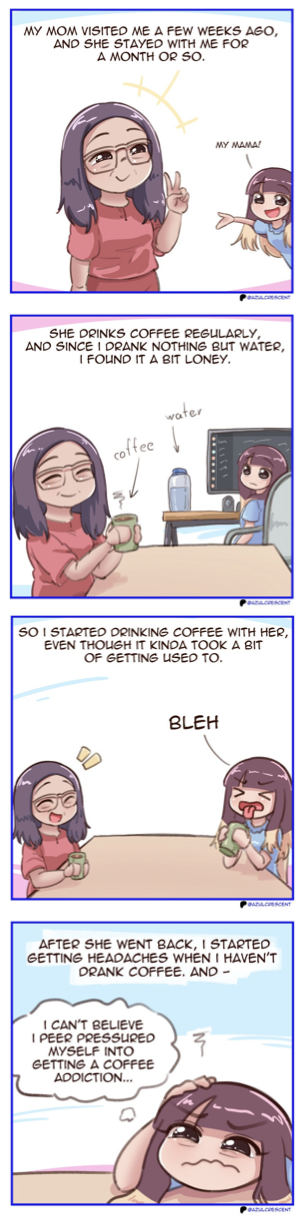
The good thing is that coffee withdrawals are over quite quickly and don’t have long-term effects.
But getting peer pressured into an addiction by one’s mom of all people is ironic.
People doing something in your immediate vicinity, without excluding you or in other ways hinting you have to do the same, are not peer pressuring you. Any obligations you feel to do the thing is entirely caused by your own insecurities.
Well, there is an innate drive to be part of a community baked into our biology. We see people enjoying something, and we want to do it too. It doesn’t need to be framed so negatively as being an insecurity, though I wouldn’t necessarily frame it as peer pressure, either. It’s more just a human desire to share in a new experience with others.
Peer pressure is the sensation of psychological pressure when deviating from peers. It doesn’t have to be caused intentionally or through active action, and it’s a basic fact of life that at least 95% of humanity experiences. (I can’t speak for all forms of neurodiversity).
You literally described peer pressure.
Ok let me rephrase it a little more clearly. There’s external peer pressure, and internal peer pressure. What I described in my other comment is a lack of external peer pressure from your surroundings, and your internal peer pressure compelling you to do something. Internal peer pressure is a problem caused by yourself, and you cannot blame that on anyone else.
Susceptibility to both what you describe as external or internal peer pressure always comes down to your own insecurities.
For example, I don’t drink alcohol and I don’t smoke. Never did. Growing up there was quite a bit of external peer pressure. But I still decided to not drink or smoke and I stuck to it. Your actions are your actions, and you can’t blame anyone for them no matter if it’s external or internal peer pressure.
But the whole premise is flawed. Having to “blame” someone for your own decisions is always a sign of not exactly being in control of yourself and your life. It’s always a sign of not being exactly mentally fit. Because this action in itself is a sign that you don’t take responsibility for your own actions, but instead look for someone else to blame your decision on.
I don’t see OOP doing that in the cartoon. She takes responsibility for her own actions. “I peer pressured myself”. She realized the mechanism at play (she wanted to fit in, and thus did something she actually didn’t want to do) and took responsibility for it. She’s not looking for blame anywhere at all.
I would argue that children and teenagers are generally susceptible to this while being perfectly developmentally healthy (though of course, not fully mature). It’s great that you weren’t susceptible to those pressures, but many others are at those ages, and that’s not indicative of any mental weakness. Susceptibility to peer pressure is a helpfully adaptive trait in many ways (it goes a long way towards making people generally more hygienic and friendly, for example), it’s just value neutral for people who aren’t yet good at predicting the long-term consequences of their decisions.
In the cartoon, no, but the OP of this thread phrased it a little more actively. I don’t have a problem with it and think it was chosen for comic effect (successfully, imo), but I think that’s what your parent commenter was responding to.
All children have a natural inclination to imitate their parents. It’s a basic instinct of childhood development.
Allistic children have this instinct
This comic is not depicting a child but an adult.
The comic is depicting a mother and daughter. No ages are given.
The daughter is artistically portrayed as smaller and more child-like than the mother, though. So consider that, from a psychological perspective.
The daughter references the mother visiting her, indicating she is living alone. That’s a somewhat decent indicator for adulthood, at least in most cultures.
My grandma just made me coffee after I was 10 days clean, and I drank it, since I didn’t want it to go to waste…
More common is getting peer pressured into an ED by your mom
ED?
eating disorder
Oh thank goodness. Here I’m thinking erectile dysfunction.
lmao… my first instinct was to type it out, i figured people shorten it as a sort of trauma filter, knew at least one person would think it was “Erectile Dysfunction” but proceeded nontheless
IDK if there’s a similar function on Lemmy, but at least on tumblr it’s recommended to tag things in full (eg: a post about eating disorders should be tagged eating disorder instead of ED or funky eating or something dumb like that) so that way filtering is easier (though, people who don’t want to see ED content would likely filter both, it’s good for when there isn’t a specific euphemism everyone uses (there are so many terms people use for rape on the internet it isn’t even funny))
Uhhh
Tell me you’re eastern european without telling me you’re eastern european
There are coffee withdrawals? I drink 2 (weak) coffees a day sometimes 3 and I have multiple times had a week or two without coffee because I forgot. I just drink it for the taste and warmth.
Caffeine dependency is a thing for sure. You’ll get some gnarly headaches for a few days and feel fatigued. Takes about 2 weeks to lose it.
It’s caffeine withdrawal. I used to get it a lot as a kid. My parents were separated and one of them had caffeinated drinks and one didn’t. When I figured out why I was getting headaches, I just stopped drinking anything with caffeine.
Some people are more or less sensitive to caffeine. Going from one coffee a day to zero has me with headaches and tiredness for a day or two.
My dad is an alcoholic and I’m convinced that I’ve inherited certain vulnerabilities to addiction. I’ve never had a problem with alcohol, but by God, when I get into a regular full-caf coffee habit, and then I miss one or two cups, the withdrawal symptoms hit me hard. I’ve been trying to slowly lower my ratio, but it’s hard to even contemplate going totally decaf when I’ve got a retail job and I’m a little scared of trying to deal with customers and withdrawal headaches at the same time.
The way caffeine works is that it allows the body to release energy reserves that it usually “locks” away from you. It allows you to tap into these reserves for concentration and makes you feel less tired.
That’s helpful for short-term use, giving you more energy and concentration.
But if you use too much caffeine for too long (“too much” depends on your body and “too long” is a few days), the body adjusts to the caffeine levels and now you have the same energy reserves and concentration that you had without caffeine before. Caffeine thus loses its effect on you and your baseline shifts, so that you need caffeine to be on the same level as before.
If you now stop your caffeine intake, this swings back. Your body thinks you are really tired and you get headaches, bad mood, low concentration and so on, until you either take in more caffeine or you abstain long enough for your baseline to shift back.
That’s why there are people who say they can’t work before they had their first coffee/energy drink. They literally can’t, because if they aren’t on the level of caffeine they are used to, their body tells them that they are super exhausted. This is the caffeine dependency/withdrawal effect.
I thought it just blocked the receptors for the chemicals that made us feel sleepy, not tapped into some hidden energy.
Correct - my best ELI5.
When you wake up your body starts producing adenosine, which slowly locks into receptors in your brain. As the day goes on, these receptors fill. By the end of the day your receptors are full which tells you you’re tired and need to go to sleep. When you sleep, these receptors clear to start the next day fresh (which is one of the reasons if you don’t sleep well, they don’t all clear and you start the day tired.)
Caffeine fits these receptor sites, preventing the adenosine from locking in and delaying the onset of fatigue. Caffeine half life is about 5-6 hours, which can lead to the “crash” as the free adenosine starts locking into the receptors the caffeine is now making available as it breaks down.
When caffeine is consumed regularly and the brain isn’t detecting the expected adenosine feedback, it responds by creating more receptors. More caffeine is now needed to account for the new receptors. If you skip caffeine with the addition of receptors, the adenosine fills the extra receptors faster and leaves you comparitively more fatigued/with withdrawal symptoms. If you reduce/abstain from caffeine for a few days the extra receptors are reduced and you return to baseline.
Tomato. Potato. Same thing
That’s basically the same thing. When you feel sleepy, you aren’t at the end of your reserves. Your body tells you that you are sleepy at a time when you still have reserves.
Blocking these receptors doesn’t tap into any magic hidden energy, it just stops your body from telling you that you are running on fumes. Thus it allows you to go farther into your reserves. In extreme cases to the point where you collapse, because you really don’t have any reserves left.
Edit: Just to be clear, going into your reserves is not a good or healthy thing. It’s not some magical potential unlocker or something, but it’s running your body under circumstances it’s not made for. If you use caffeine when you really should be sleeping, that’s short-term ok, but can lead to some serious consequences in the long term.
deleted by creator
It’s one case where I’d argue that the most literal interpretation should apply, dictionary definition be damned. Your authority figures are not your peers.
Once youre an adult parents should not longer be authority figures.
Also, someone drinking coffee without you isn’t peer pressure.