
…
Together with its Big Tech allies, and far-right think tanks, the Trump administration has launched a full-scale attack on the EU’s digital rules.
…
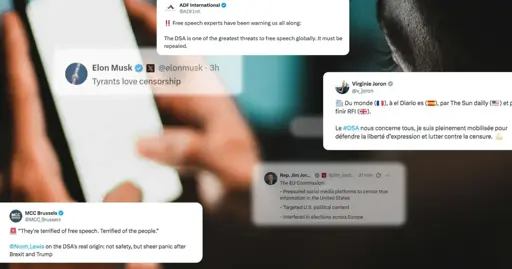
US far-right think tanks [focus] on EU digital regulations, especially on the Digital Services Act (DSA), which sets out a framework for content moderation on social media. These attacks are supported in Brussels by conservative organisations close to the Hungarian government, Christian fundamentalists and by far-right MEPs. On 2 and 3 February this year, the Patriots for Europe group, chaired by Jordan Bardella, co-hosted a transatlantic summit in the European Parliament with several figures from the MAGA sphere and the international far-right discussing what they describe as threats to “free expression”.
…
The objectives of the DSA are widely supported and no significant objections were raised when it was adopted. According to an October 2025 YouGov opinion poll, 53% of French respondents said that social media are not sufficiently regulated, while only 6% felt they are unduly restricted. Over the past years, there have been numerous social media scandals, including the sale of child-like sex dolls by the Chinese e-commerce giant Shein, online harassment, pictures of people being undressed by the AI chat-bot Grok, and harmful TikTok content for teenagers. There have also been disinformation campaigns by third countries, such as Russia, detected on X or Facebook.
…
The DSA did not present a major problem for Big Tech firms either. “When the DSA was passed, Big Tech companies were positive about the legislation”, says Jan Penfrat, a Senior policy advisor at European Digital Rights (EDRi).
…
Everything changed when Donald Trump returned to power. He has been very vocal against content moderation policies ever since his Facebook and Twitter accounts were suspended following the Capitol riots in 2021. On the very day of his inauguration, he signed an executive order called “Restoring Freedom of Speech and Ending Federal Censorship” prohibiting the administration from fighting disinformation. A few weeks earlier, Mark Zuckerberg had announced the end of moderation on his social media platforms, stating that “Europe has an ever-increasing number of laws institutionalizing censorship”. “Attacking the DSA and moderation on social media might have seemed like a good way of getting closer to Trump,” says Bram Vranken, a Researcher and campaigner at Corporate Europe Observatory.
…
“The censorship narrative is repeated on a daily basis on Fox News, on X… When the UK opens an investigation because Grok undresses children online, Elon Musk will say it is censorship,” says Berin Szoka, president of TechFreedom, a think tank that gets funding from digital giants including Google and Meta.
“I make a distinction between ‘normal’ digital giants and another very Trumpist component in this sector,” he says. “Those who say they are libertarian, like Thiel, Sacks or Lonsdale, are mad. And they have funded an entire ecosystem of organisations such as the Federalist Society and the Internet Accountability Project to promote their ideas.” Sidenote
According to them, the main reason why these (anti-immigration, anti-LGBTQ+ and pro-birth) ideas have so little resonance among the general public is because they are censored on online platforms, as a result of the influence wielded by ‘progressive’ elites they want to do away with.
…
But while the Trump administration has opened fire on the Digital Services Act, at home it has launched a chilling and blistering attack on free speech, from putting pressure on media to silence critical voices, to opening criminal investigations against critics and political opponents.
The new National Security Strategy, released at the end of last year, clearly indicates the aim to support far-right parties in Europe (“the growing influence of patriotic European parties indeed gives cause for great optimism”), while promoting the conspiracy and racist ‘Great Replacement’ theory (“within a few decades at the latest, certain NATO members will become majority non-European”).
“To justify such a thing, they need to claim moral superiority, they need to be able to portray themselves as the ‘good guys’, Berin Szoka [the president of TechFreedom, a think tank that gets funding from digital giants including Google and Meta] points out. “If you want to be able to say that the US supports a “resistance” in Europe – and that resistance is actually the far-right - you need to say that the other parties are going after free speech.”
…
Far-right think tanks are playing an important role in the US campaign against EU digital rules. The Claremont Institute, a longstanding supporter of Trump, published a long rant against the Digital Services Act in 2025 entitled “Make Speech Free Again” … The Heritage Foundation [the think tank that coordinated Project 2025 and has effectively become an extension of the Trump administration] has also been tasked by the Trump administration to select EU-based think tanks that would get funding from the US government. The aim: to target the UK’s Online Safety Act and the EU’s Digital Services Act.
If more evidence were needed of conservative alignment on this issue, in January 2026 the America First Policy Institute, a think tank set up by the first Trump administration and which provided several members of the second Trump administration, posted a video on social media accusing “the EU unelected bureaucrats [of wanting] to crush our free speech” by targeting the DSA explicitly. The fine against X and Elon Musk is presented as an attack by Europeans against ‘the Americans’.
…
Although freedom of speech is a fundamental right in Europe, it must be balanced with other rights, including the right not to be discriminated against. This approach explains why there are laws that penalise racist and revisionist views. In some cases, in the EU as well as the US, human rights organisations have criticised governments for unduly limiting freedom of expression through anti-terrorism laws, for instance, to censor pro-Palestinian voices.
“In some countries, there are laws that unduly restrict freedom of speech. This has nothing to do with the DSA, but Republicans will exploit it,” says Berin Szoka.
…
many EU regulations are a thorn in the eye of tech multinationals. “During its previous mandate, the EU tried to make a ‘tech deal,’ a package of digital legal texts based in part on specific EU standards such as the General Data Protection Regulation (GDPR),” says David Cormand. These include the Digital Markets Act (DMA), which is designed to fight digital giants’ anti-competitive practices, and the AI Act, which establishes a framework for the use and development of Artificial Intelligence. By joining forces with the Trump administration against the DSA, Big Tech knows it can rely on the Trump administration to put pressure on EU legislation as well.
…
They can also count on the support of the European far right, which has already expressed support for the Digital Omnibus, a Commission proposal aimed at weakening the GDPR and the AI Act. Since the start of the parliamentary term in June 2024, Meta has met fifty-five times with MEPs from European Conservatives and Reformists, Patriots for Europe, and Europe of Sovereign Nations (as of the time of publication). Since August 2025, Meta has had the most meetings with the far-right Patriots for Europe, more than with the far larger right-wing EPP party. Just a few days after the Digital Omnibus was proposed by the Commission, the Head of Public Affairs of Google France attended a dinner in Strasbourg hosted by six National Rally MEPs, including Virginie Joron.
…
All far-right groups must be prohibited and dismantled, and the wealth of their corrupt rich supporters should be removed and distributed among all of society!
Freedom of speech can only exist when the fascists cannot attack it! Long live communism, long live confessionalism, and long live social liberalism.
Well said, we need thousands more like you saying this! Make nazis bad again, end the Epstein class asap!
If the alternative to american big tech, is chat control and survailance by the EU or EU countries governments, I actually prefer American Big Tech companies though. We should strive towards free liberal social medias, without personal data being compremised. I rather my data go to branding/commercialized purposes, than actual survailance of my personal life.
You do realise that governments could either force companies to disclose data, or buy information from data brokers? And big American techs are politically involved by lobbying to dilute laws protecting people? What made you think that American big techs are as innocent as you thought
Also, if you think your data goes for “commercialisation” purpose, think again. Politicians buy data from firms to study the voting patterns and beliefs of individuals to sway voters. See the Cambridge Analytica scandal.
That has litterally become illegal on metas platforms now. So, your point is? I hate American big tech as much as anyone. But if the EU starts chat control and “Age verification”-apps, its litterally over. Right now, I atleast have the option to delete my socials and not using facebook. If EU chatcontrol enters the game, freedom is over.
I prefer privacy over both, which is what GDPR is doing. And commercialized purposes or government surveillance is the same when the government can just buy data from corporations.
Also, far right and big tech is anti-regulation while being pro surveillance, viz child verification laws in California sponsored by big tech.
Two turds doesn’t make it a flower, it’s just double the amount of turd.
