

I never knew who I was. I still don’t know who I am. It doesn’t matter anyway.

  • 0 Posts
  • 17 Comments
Joined 3 days ago
cake
Cake day: February 23rd, 2026

help-circle

  • @[email protected] @[email protected] @[email protected]

    The most menacing thing in that picture is the bold red text, assuming it isn’t Photoshopped that way

    I’m interacting from Sharkey, on a Lemmy thread, and you’re interacting from PieFed. I’m not sure if PieFed fetches the alt-text from images. If you access my original Sharkey note, you’ll see the following alt-text:

    Screenshot of confirmation dialog “Block AI enhancements?” with “or pop-ups about them” highlighted.

    I disclosed the fact that “or pop-ups about them” was highlighted. Also, a quick reverse image search would point to the original picture where said excerpt isn’t highlighted.

    It would be photoshopping/photo manipulation if I removed, added or changed text from the picture, which I didn’t.

    I’ve seen Firefox implement other dark patterns, including hiding the ability to disable ads from within the homepage

    Exactly, and even this one is a matter of conundrum when it’s brought to the table. Because Mozilla, and corporations in general, know the exact, dosimetric approach of pushing dark patterns, not too hard so all the user base would readily notice and complain, not too soft so all the shareholders wouldn’t see the “graph line go up”. Just the right amount to make things dance to their song.

    Even today, stating how the opting-out of “Sponsored shortcuts” isn’t trivial for the average user (not to mention how said user will see the sponsored shortcuts at least once as they head to turn them off), is met with people blindly advocating for Mozilla (which, let us remember, they’re a corporation with corporate interests, not a lifelong friend or a fellow trustworthy acquaintance, and corporations are driven by profit, not by friendship or psychological well-being).

    But this isn’t really one of them

    The opt-out implies a feature that was pushed without consent.

    Again, I bring my heavy hypothetical example: if a harasser offers the harassed a way out of the harassment after having initiated the harassment, would this make the harasser less of a harasser? Hell no, of course no! It’s still harassment! It turns out opt-out features are exactly that: something that gives you the “right” to leave, only after it was pushed onto you.

    And The fact that “opting-out” requires double confirmation only makes it worse, as if the hypothetical harassed were to be ask by the hypothetical harasser “are you sure you don’t want this?” before being “allowed” to be freed from the hypothetical harassment.

    Users have been begging Mozilla for StartPage integration, but Mozilla gave them a Perplexity integration instead.

    Exactly, another dark pattern, and another proof of how Mozilla is not a friend, but a corporation.

    the ones that give them money

    Yeah. And this is often the justification people often use to advocate for that: “oh, but Mozilla needs to mane money” (at what cost?), as if donation-based economy weren’t a thing.

  • @[email protected] @[email protected] @[email protected]

    asking for a confirmation before turning on/off the AI functionalities

    The thing is, there doesn’t seem to be confirmation before turning clankers on (at least I didn’t find screenshots in this regard), but there is such a confirmation before turning the whole thing off (that is, from the default-on state Mozilla pushed unto the software upon updating/installing).

    If both situations involved double confirmation dialog in a symmetrical manner (“are you sure you want to proceed with activating this feature?” coexisting with “are you sure you want to opt-off from this feature?”), that would be fair. Pretty annoying, but fair. But this fairness doesn’t seem to be happening, no confirmation dialog seems to exist for actually using the feature. The only thing similar to a “confirmation” during further usage of “AI Enhancements” would be the authentication step from whatever clanker was chosen from the suspiciously-biased list of clankers (ChatGPT, Claude, Gemini, Llama, Mistral; no non-Western options such as Qwen or DeepSeek, for example).

    as it is a disruptive action that affect overall users

    How disruptive would be turning off a feature that is far from being essential to browsing (and, in practice, may end up rendering the whole browsing experience worse with inaccurate summarization and potential vulnerabilities (prompt injection, remote code execution, etc), produced by pieces of software explicitly labeled as “it may produce inaccuracies”)?

    Not to say how, as I mentioned initially, the entire premise of bringing it as default-on with now the added “right” to “opt-off” is, itself, non-consensual relationship, insofar the user didn’t seek it by themselves. Clankers would be a nice feature for some niches and use cases (again: I myself use LLMs, but it stems from my own decision to do so, not because it was pushed onto me; something I opted-in), but it should be voluntarily sought, installed and turned on by the user as they please, not as “default-on” option.

    Anyway, all good. It is nice to see people with this kind of concerns

    Sure, no problems, that’s reciprocal, we’re good! Throughout my exchanges in this entire thread, I tried to keep it respectful (at least when it comes to the debate and my peers; of course I’m fiercely criticizing Mozilla Corporation, because they were once the ones who “will never sell your data”) and trying to debate the idea and not the peer’s person.

    My concerns, in the end of the day, are just an attempt to advocate for the total, non-negotiable autonomy and Free Will (as far as Free Will can get in a deterministic cosmic existence) of users, far from just my own; and this involves denouncing potential corporate biases whenever a corporation brings up another brick in the already-tall wall of enshittification, naming and shaming corporations for their greedy corporate behavior.


  • @[email protected] @[email protected] @[email protected]

    Maybe I’m overly idealistic when it comes to software but, IMHO, a software (especially a browser) should be the least distractive possible. My point about modals was about feature announcement pop-ups (“Now you can do Y… Click on Z menu to get into Y”), the ones which Mozilla Firefox explicitly mentioned within the confirmation dialog, as well as the said confirmation dialog which, as far as I could find about, is one-sided, for there are no confirmation dialog to the other action, which is to activate the clankers.

    The ideal workflow, to me, is as follows: the user launches the browser software, the main UI opens minimalistically listing the most frequently accessed websites and the pinned bookmarks, the user clicks on some shortcut or types in some URL, then the browser fetches the network content from said website, parses it, fetches whatever else needs to be fetched for the specific website, renders it visible on the screen, then let the user interact with the page as they please, without a MS Clippy-like behavior of reminding the user “It looks like this page has links, you can summarize them using a clanker” on a frequent basis.

    Lynx, for example, is the perfect example of this, it’s not an utopia I’m imagining: I type lynx and I press enter, then Lynx executes and brings its TUI, then I press g and type the URL of a website, and it fetches and does what needs to be done in order to bring up the website to the TUI. No cluttered interface except for the short list of keyboard shortcuts at the bottom which don’t require user interaction nor disturb the UX. That’s KISS approach.

    When a browser has a MS Clippy-like behavior and, most importantly, when a browser brings potentially unwanted features turned on by default, whose opt-out requires the user to go through some sort of gymnastics while the usage of said feature is asymmetrically easy (seemingly no “confirm you want to use the clanker? The clanker may have access to the following: page content, currently open tabs, credentials on the page, etc…” like the opt-out confirmation dialog lists exhaustively about “enhancements that will be unavailable while the user opts out of Firefox AI enhancements”), again: perhaps I’m being too pedantic but, to me, it smells, it looks, it behaves and it whispers like a dark pattern.


  • @[email protected] @[email protected]

    When we develop a system (I used to work as a DevOps for almost 10 years), the technical aspects aren’t the only aspects being accounted for: especially when it comes to the front-end (i.e. the UI the user sees, the UX how user interaction will happen and how it may be perceived by them), psychology (especially behaviorism) is sine qua non.

    Shapes and colors often carry archetypal meanings: a red element feels “dangerous”, a window with a yellow triangle icon feels to be “warning” about something, a green button feels “okayish”. I mean, those are the exact same principles behind traffic lights.

    And signs and symbols, ruling the world, don’t exist in a vacuum: a colored button besides a monochromatic button may, psychologically, lead to a feeling that the colored button is the proper way to proceed.

    But… there’s a twist: imagine you have a light-gray “Cancel” and a colored (regardless of the color) “Block”. “Block” is a strong word. The length of the label text also does impart psychological effects. The human brain may see: “huh, I have this button which reads ‘block’ and it’s quite strong, and this other button which reads ‘cancel’ and it’s more easy to the eyes, maybe ‘block’ is dangerous”. Contrast matters: the comparison between a substrate and the substances is pretty much how we’re wired to navigate this world as living beings.

    Now, corporations such as Apple (Safari), Google (Chromium), and very likely Mozilla (Firefox) as well, they have entire hordes of psychologists directly working for them, likely the same psychologists who’ll work together with their HR departments for evaluating the candidates who applied for a job position there. These psychologists, and/or psychoanalysts, they know about Jungian archetypes, they know about fight-or-flight response and other facets of our deeply-ingrained instincts, they know about how colors are generally perceived by the human brain. Those psychologists likely played a role when a brand was chosen, or when an advertisement pitch was made. They know what they’re doing.

    UX/UI decisions are far from random choices from the leading team of project management engineers, it involved designers with psychologists. Again: they know what they’re doing, they know it pretty well. They know how the users are likely to keep the functionality. They know how the users, as Ulrich said, are very unlikely to touch the settings, likely to keep the defaults, no matter what those defaults are. Because they know humans are driven by the “least-effort” instinct, which is quite of a fundamental principle shared among living beings as a byproduct of the “lowest energetic point” (thermodynamic equilibrium) principle.

    To me, a former full-stack developer, the newer Firefox interfaces don’t feel like Firefox is being psychologically fair and honest with the user’s mind. Dark patterns are often subtle, and they’re part of a purposeful, corporate decision.


  • @[email protected] @[email protected]

    I’m not referring only to the feature per se, I’m also referring to any pop-up designed to appear throughout the navigation to “remind the user about the superb features”.

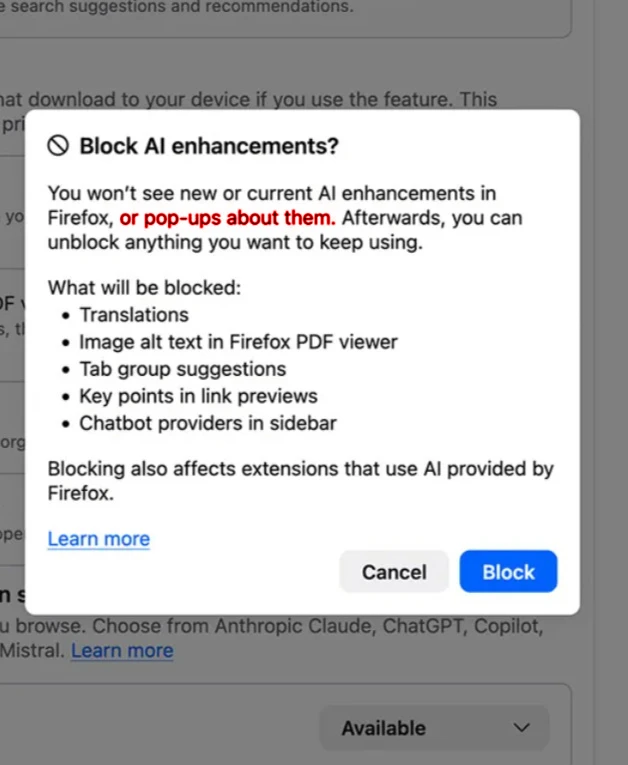
    Said pop-up is explicitly mentioned on their “confirmation dialog” upon turning off (screenshot attached below):

    You won’t see new or current AI enhancements in Firefox, or pop-ups about them.

    It speaks volumes about how much a dark pattern this is, the fact that the opt-off has a confirmation dialog, while the further proceeding with logging in with Anthropic/OpenAI/Google/Meta account doesn’t seem to have a confirmation dialog.

    And the fact that the confirmation feels “menacing” and defaulted to cancelling the opting-off (i.e. pressing “esc” or clicking outside the window; one must click the primary-colored “block” button which, contrasted to a grayish “Cancel” button, may psychologically induce the user into thinking “block” is a dangerous action), quite similar to the about:config warning screen.

    Ah, and the clanker options: notice the lack of alternative options for those who want a custom clanker, such as DeepSeek, Qwen, Z AI, Brazilian Maritaca IA and Amazônia IA (to mention some non-Chinese LLMs), or even something running locally through ollama. Seemingly no option for using a custom, possibly self-hosted LLM endpoint. The fact that all the options offered are all heavily corporate options (with Mistral being the “least corporate” of them all, but still Global Northern nonetheless) might tell us something…

    All of these dark patterns, among others not mentioned, are the object of my critique, not just the fact that Mozilla is shoving clankers unto Firefox.

    Whenever a feature needs an invasive pop-up and the opt-out brings up a second pop-up that requires further confirmation (but none seems to be offered upon actually using said feature), it is called a dark pattern, no matter if said feature requires further configuration.

    Screenshot of confirmation dialog "Block AI enhancements?" with "or pop-ups about them" highlighted.


  • @[email protected] @[email protected]

    Because people overwhelmingly do not change any defaults whatsoever

    Most roosters wouldn’t normally seek the paws of the fox to be hugged by, what an astonishing news!

    You see, that’s exactly what plays favorably for things pushed with “opt-out” mechanisms, anything. If people are less likely to change the settings to better enhance their UX (be it due to a lack of knowledge, a lack of proactive pursuit or because they deem their current settings “good enough”), this means people would be more likely to have the clankers shoved down their throats if said clankers were to be part of default settings.

    In fact, if settings would very likely go unchanged, then Mozilla could push anything, absolutely anything under they will, “shall be the whole of the Law” with the legally-required “opt-out” mechanisms in place.

    In the foreseeable future, we’d have Firefox as a new “Agentic Browser” where a clanker does all the tiring and utterly boring effort of “browsing the web” as the user watches their credit card being depleted by prompt injections carefully placed amidst Unicode exploits across the web by scammers. But, hey, let us not worry, there’s always a button to turn it off! 😄


  • @[email protected] @[email protected]

    If it’s opt-in it may as well not exist

    Just because if it were opt-in, people wouldn’t have chosen to activate it, and fewer people would use it and the graph line wouldn’t go up for the shareholders to appreciate? Then, maybe, just maybe, it would be quite a strong evidence that this isn’t really something that the users want, don’t ya think?

    For whatever reason, they have decided it’s important.

    There’s the reason, right above this paragraph: one can only achieve what people would certainly refuse, if they pushed it onto people by use of force (not necessarily physical force, but, for example, dark pattern is a technical means of “force”).

    A fox can’t convince the roosters to become her food, if the roosters were to have a stake on deciding in this regard, less roosters would become a tasty dinner for the cute fox, because becoming a tasty dinner isn’t exactly a demand from roosters. Hence why the fox must grab the roosters, but in this case the fox gives them an option to escape from her paws.

    Ah, notice your own phrasing: “They have decided”. Who have decided? Not the user, not the party interested in their own UX/UI, but the very archontic architects of a kind of digital apparatus we’ve been compelled to use for participating in this digital realm of society (risking social ostracism if we don’t), the World Wide Web.

    And when a decision is made upon someone, without regard for the very someone upon which the decision is being made, even when there’s some kind of “opting out” from the object of decision, we had a name for that: it was called “non-consensual relationship”.


  • @[email protected] @[email protected]

    The problem still remains: why’s this thing “opt-out” and not “opt-in”? Why not make it an official, totally optional (as in voluntarily wanting to have it and, only then, proceeding to have it) plug-in or extension that the user (let us remember the meaning of “User Agent”: an agent acting on behalf of the user, not a piece of software who’s become “the user”) could install at any moment, out of their own will?

    I’m far from being an anti-AI person, I myself use those clankers on a daily basis. However, I use them because I want to, while I still want to, not because they were pushed unto me.

    Mechanisms of “opt-out” where there should be an “opt-in” is a form of dark pattern.

    In fact, the very concept of “opting-out” is a dark pattern per se, because it implies something pushed unto a person, something from which they were “allowed” the “right to leave”.

    Yeah, it’s awesome to have means of “opting-out” from something, but having an “opt-out” mechanism in place doesn’t mitigate the very fact that it was coercively pushed unto the person beforehand and didn’t require explicit consent from the person unto which the thing was pushed.

    Speaking of “consent”, situations like these are not that much different from the dark pattern “Yes / Not now” we’ve been seen everywhere: in certain scenarious, this insistence and disregard for explicit consent would verge the criminal (e.g. harassment), but suddenly it’s “okay” when corporations (and the State itself) do it.

    If, say, a situation where someone is being harassed and, only after having started to harass, the harasser offers the harassed a means to leave the harassment, does this make the harasser less of a harasser? Because that’s the same absurd logic behind the corporate advocacy whenever it’s said “oh, but Mozilla is offering an opt-out, you can always turn off ‘sponsored shortcuts’ (that is, after having been faced by the shortcut from a Jeff Bezos corp as you proceeded to open a new tab for accessing the opting-out settings, but that’s totally okay), ‘sponsored wallpapers’, and the ‘Anonym tracking’, and now you can, check this out, you can turn off the clankers, too! Wow, isn’t that such a cute corp, the corp with the cute fiery fox mascot?”.

    Not to say how it’s gonna end up cluttering the upstream with (more) binary blobs, adding to the Sisyphean struggle that WaterFox, IronFox, LibreWolf, Fennec, among other Firefox forks, have been experiencing upon trying to de-enshittificate the enshittificated and de-combobulate the combobulated.

    Mozilla needs to make money”. Yeah, yeah, because the very fundamental, immutable principle of cosmic existence boils down to “there’s no such thing as a free lunch”, amirite? After all, “money” is clearly within the table of elementary particles alongside quarks and gluons, isn’t it? And Mozilla needs to make money… We had a tool for that: it’s called donations.


  • @[email protected] @[email protected]

    Possibly. I don’t know the specific acronym they use, but regardless of the acronym: to me, it smells and looks like NDAs insofar it’s some kind of analogous version of a “secretive initiation ritual” for a developer who’s just trying to help an open-source community. It’s an agreement where the developer accepts that anything they contribute free-of-charge is going to be used for enterprise (paid) purposes and any contribution is subject to be altered or removed as the management pleases, sometimes it also involves literal NDA if private (often “enterprise/premium edition”) repos are intertwined with the open-source (“community edition”) repos.

    The ideal open-source, at least to me, would require a developer, any developer no matter who they are or how long their experience is, whenever they wanted to contribute with their coding skills, to simply do a PR or fork a repo, with no bureaucratic or “selling the soul to the Great Corporate” requirements for doing so.

    Developing is already mentally demanding for a developer, and adding licensing shenanigans to the equation only complicates things, because now the developer, who’s used to talk the language of computers, would need to become knowledgeable about ambiguous social cues, corporate legalese and the differences between a “MIT” and a “GPL” (that’s one of the main reasons why I’m quite fond of WTFNMFPL licensing: no legalese).


  • @[email protected] @[email protected]

    Yeah, me too. Unfortunately, the forks can only get so far in removing upstream AI garbage and other proprietary/corporate-oriented whistles-and-bells. If, say, some AI feature becomes so ingrained inside Firefox upstream, so deeply it ends up becoming some hard dependency for fundamental functioning of the browser (i.e. a feature that, if removed at the code-level, would render Firefox simply unable to function), no WaterFox, IronFox, Fennec or LibreWolf would be able to keep up with the latest versions: they’d either need to do a hard fork trying to independently maintain an entire codebase for a browser, or they’d need to use downgraded versions.

    Not even to say about licensing shenanigans. We’ve seen many open-source projects suddenly changing their licensing to include legalese thin letters. We’ve seen open-source projects requiring developers to sign up some kind of NDA before being allowed to contribute with code. Seems like initially-open licenses aren’t written on stone when it comes to big projects, and Firefox is a big project.

    The universe of open-source software is being slowly hijacked by corporate interests. This is not different with Firefox, which (as I said in another reply to someone in this thread a few minutes ago) is Mozilla’s main product (if not the main product, it’s certainly among their main projects). The same Mozilla which has been pivoting to AI (e.g. acquisition of Anonym; subtle phrasing changes from “About Firefox” page which used to state how “Firefox will never sell your data”, now this phrase is gone).

    I use WaterFox on a daily basis. It’s by far the best browser I’ve been using. I tried LibreWolf but it doesn’t really likes my Portuguese ABNT2 keyboard (which has accents I use often), even after disabling ResistFingerprint, so I ended up sticking with WaterFox. On mobile, I use Fennec on a daily basis, and I’m worried about the end of “sideloading” on Android which will likely mess with its installation. But I’m aware of how both browsers rely on upstream code from Mozilla Firefox, whose enshittification is already an ongoing phenomenon. And that’s really depressing when it comes to the future of browser landscape, because we’re hoping for a true alternative. Servo is the last bastion of said hope (until it gets EEE’d by corporate interests, given how Linux Foundation itself is increasingly surrounded by corpos.

    I’m more of a GNU/Stallman person who values autonomy and libreness as non-negotiable principles. I’m only using Android because I’m stuck with it due to certain societal impositions (banks and gov apps), otherwise I’d be long using a custom phone, which wouldn’t even be Linux, but something way more “unorthodox” for a phone such as FreeBSD or Illumos/OpenIndianna, systems of which I already used on a PC environment and got quite fond of.


  • @[email protected] @[email protected]

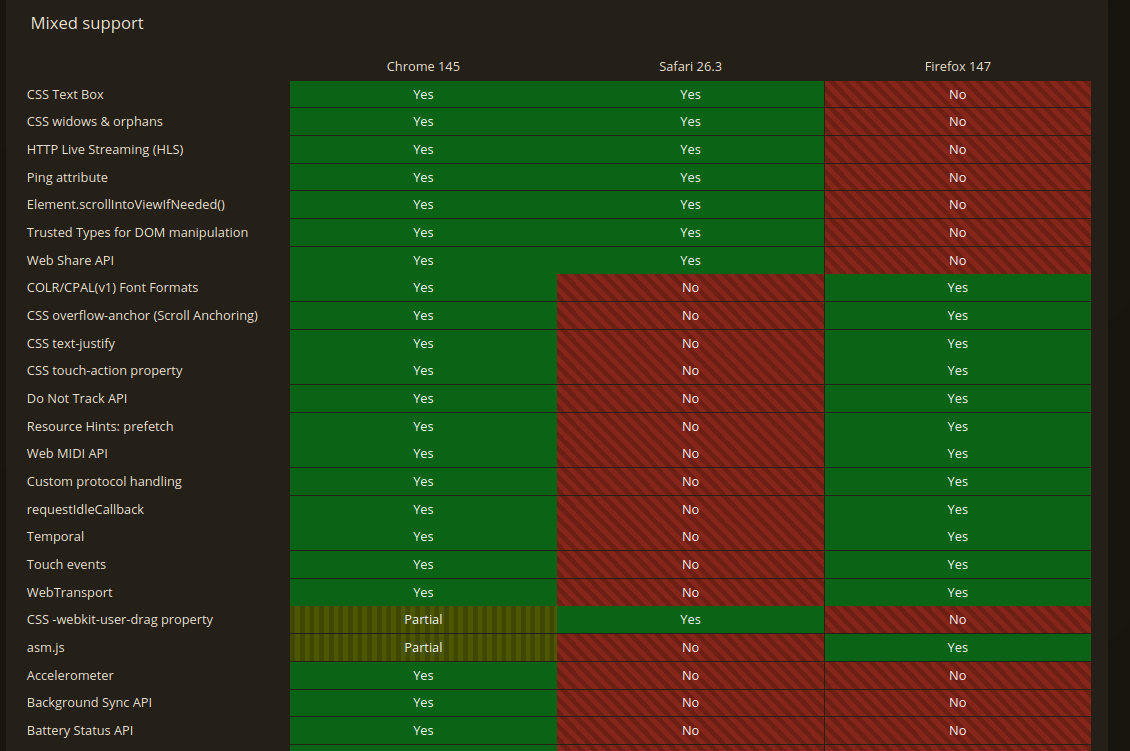
    It takes the same 30 seconds of using caniuse.com (screenshot below), which doesn’t list WebKit-GTK specifically, but lists Safari (which is WebKit under the hood), for it to become clear how many things are missing from Safari implementation (which is WebKit).

    To be fair, yes, there are many bleeding edge features, some of them implemented only on WebKit/Safari, but those Safari-only features are kind of proprietary features (prefixed by -webkit-). Similarly, there are indeed many features still missing from Firefox while already implemented for the two other engines (such as CSS @function).

    But my point, which I should’ve gone into further detail earlier, is that WebKit, primarily maintained by Apple (originally authored by Apple, and a trademark of Apple since 2013), doesn’t have the same, browser-focused teams found on Mozilla (whose main product is Firefox) and Google (whose main product is advertisement through their platforms, including Chrome, so Chrome is part of their main focus just because that’s essential to keep the ads running and telemetry sneaking on the user). Apple is more focused on other businesses, such as hardware and UI, Safari and WebKit are their side-project.

    Screenshot of the "Mixed support" section of caniuse.com comparing Chrome, Safari and Firefox browsers side-by-side.


  • @[email protected] @[email protected]

    Oh, right, WebKit, I forgot mentioning it, thanks for reminding me of it!

    It’s the engine I likely used the least throughout my digital existence. I mean, I likely used Lynx more than I used WebKit, hence my forgetfulness.

    However, if we’re talking about the WebKit-based Linux browsers (such as Konqueror), IIRC, they’re a bit out of spec when it comes to the “modern Web”: WebKit’s adoption of latest specs tends to be slower than Firefox and Chromium.

    Now, if we’re talking about Safari specifically, then… it’s part of Apple’s walled garden, one where even “Firefox from App Store” is actually a reskinned Safari (at least in iOS).

    Be it Safari or Konqueror, deep inside, the WebKit engine seems to me like the “Apple’s Chromium”, so mentioning WebKit doesn’t really improve the awful prospect for browser engines that we’re facing nowadays.


  • @[email protected] @[email protected]

    Ah, the smell of irony by the morning! Adopting a programming language often praised by its “safety”, while the entire pretension of “safety” is alchemically transmuted into a sewage and deliberately flushed up (not down) by a clanker who drinks from the cesspool with the same determination and thirst that of a Chevy Opala gurgling down entire Olympic pools worth of gasoline.

    Being serious now, the foreseeable future for Web browsing is definitely depressing: Chromium needs no introduction (used to be an interesting browser until Google’s mask “don’t be evil” fell and straightforwardly revealed their corporate face and farce), Firefox have been “welcoming the new AI overlords” for a while, text browsers (such as Lynx) are far from feasible for a CAPTCHA(and Anubis)-driven web… now, one of the latest and fewest glimmers of hope, an alternative Web browser engine, is becoming the very monster the fight against which was promised to be the launchpad purpose (“They who fights with monsters should be careful lest they thereby become a monster”). I wouldn’t be surprised if Servo were to enshittify, too. Being able to choose among the sameness is such a wonderful thing, isn’t it?

    I mean, I’m not the average Lemmy user who got this (understandably) deep hatred against AI, I am able to hold a nuanced view and finding quite interesting uses (especially when it comes to linguistics) for the clankers (especially the “open-weighted” ones). However, this, to shoving AI everywhere and using AI to “code for you”, it’s a whole different story. A software should be programmed in the way programming (as posited by Ada Lovelace) was intended to, not “vibe coded” by a fancy auto-completer who can’t (yet) deal with Turing completeness, especially when it comes to a whole miniature operational system that browsers became nowadays. When coding a whole OS, AI shouldn’t even be touched by a two million light-years pole, let alone by a two-feet pole.