I dunno how it works in the US but in Aus I can’t deduct anything unless it’s related to work, apparently feeding and housing myself doesn’t contribute to that …
In a lot of places a part of your income is exempt from taxes (eg brackets where you pay 0-20k @ 0%, 30-60k @ 30%, 60-100k @ 40%, 100k+ @ 50%; then your first 20k is not taxed), i think this is what they are talking about.
Edit: another possibility would be they do mean actual expenses, just reminded you can (partially) deduct education expenses from your taxes in the Netherlands.
I guess you could argue that that’s the reasoning behind the progressive tax regime. Australia’s progressive tax lines up with the low end of that but if you were going to claim that the tax free threshold was to cover general living expenses then it’s going to need to be a lot larger, 20k bere is not enough to cover rent, food and utilities here, a 3x2 near Perth is like $800/week for rent and I would argue interest on a mortgage is comparable and Perth is on the cheap end of Australian cities. That’s like 40k without utilities and food. So either the tax free threshold was poorly implemented without indexation against inflation and cost of living or the driver of it isn’t to cover basic cost of living and is more to ease the burden on the poor end of town. I guess you could say it’s a little bit of both but arguably indexation should be implemented.
Standard deduction is slightly different than an exemption. You’re deducting a set amount (instead of itemizing it, which only makes sense to do if the total is more than the standard deduction, which it won’t be for most professions).
An exception exemption would be removing a portion of the taxable income before it is taxed.
Pretty similar outcome for most people, but still an important distinction.
From State tax, but that’s still not related to the federal deduction, where it only kicks in you itemize.
However while you may not be able to deduct your property taxes if you own a house with standard deduction, you do get to if you are a landlord regardless of standard deduction.
Point is a couple shares rent. A couple’s residence is unlikely to be twice the cost of a single residence, unless you have roommates. So 30k for a couple guess further than 15k living alone.
Exactly. It’s to incentivize one person to be a bread winner and one to make less and be a home maker (or something with less hours) so you get the tax benefits. It would be a nice system if expenses weren’t so damn high.
Homemaker or not, marriage promotes economic stability because of tying folks outcomes together. As an edifice, the State likes that a spouse probably steps in before aid programs or whatever.
Married couples get the same tax benefits regardless. A raise for the lower earner always means more money for the family, so no, it doesn’t incentivize having a breadwinner over having equal pay.
Let’s do a quick exercise without real numbers. Please let me know if I’m wrong because this is what I thought. If I make 150k and am maxed out on my standard deduction, but then I make 250k and there’s no difference on my standard deduction, I’m not getting more standard deduction. If my wife is a stay at home mom and I make $250k, I am getting more standard deduction now, right?
This is how married taxes work, right? Am I wrong on that? We get different brackets and different rules. I’ve been marred for 7 years and my first year I got all my taxes back because she didn’t work that year. Am I wrong?
But what you’re saying: a raise for the lower earner does give more money. But by being a big earner marrying a now or low earner, it incentivizes high earners marrying low earners. Or mixed earners. It was devised in the time when women didnt work but we needed more tax benefits for taking care of women.
No. You’re correct. You would get less money back on your taxes if your wife’s income went up. However, the amount your taxes go up is less than the increase to your wife’s income, so you still end up ahead as a couple. You get the largest individual tax breaks when you have a breadwinner, but the total financial incentive (after tax returns) is for both partners to make as much money as possible.
That said, finances are very emotionally charged and how people should approach their finances depends on how they think about this stuff. That’s why snowball debt strategies work - not because they are optimal financially, but because they play into the psychology of a human paying off debt. With that in mind, I suppose you could still feel incentivized to have a large difference in incomes because of the tax breaks - it just isn’t financially optimal if there is a free opportunity for the lower earner to bring in more money.
Payroll tax is not a tax on business, it’s also a tax on workers, it’s just business is deducting it automatically, and paying it to government, to reduce the amount of transactions.
Yes and no. You’re right of course that part of pay is withheld and paid as tax, but that isn’t what I was referring to. There is an additional component, beyond what is withheld from employee pay, which is paid directly from the business to the state which the employee never sees. It’s a similar amount.
When our business decides how much we can afford to pay someone for a position, the math is always with what that payroll tax is included.
So without the payroll tax we may be able to afford paying someone $25/hour.
With it we may only be able to afford to pay them $22/hour.
It reduces the amount we can afford to pay the employee, even though it’s technically never given to them in the first place it’s money that could have gone to them.
I would love to pay more but that tax takes it out of my hands.
I take it that they mean that it is indirectly a tax on the employee in the sense that it is money the employee could have earned but does not because the company has to pay the tax. Could have earned as in the salary could have been higher without it.
On the otherhand, that is true for any tax a company has to pay, just not as directly releated.
(Or I could be wrong and they mean something else.)
that is true for any tax a company has to pay, just not as directly releated
Not really, salary and automatic tux deduction is the same line of the budget for the company, it’s money they spend directly on employer. For them there is absolutely no difference do the money come to employer or to the government, they spend X amount of money so the employer works for them, it’s the same chunk of money regardless of what percentage goes where.
That’s, like, completely the opposite of the argument. Saying that payroll tax is a tax on business is like saying sales tax is a tax on business. In both cases, the tax is paid from the money that otherwise could come to a human, it’s just business is deducting it automatically.
In both cases, the tax is paid from the money that otherwise could come to a human, it’s just business is deducting it automatically.
Sales tax is paid by the customer, not the business. I … don’t know why you think it’s automatically deducted by the business? Unless you mean B2B purchases
Do you, a person buying your whatever the fuck, then later sending a separate transfer to the government with sales tax? Or, if you’re paying cash, do you later set your sales tax for that purchase aside and send it to the government in a separate envelope?
If you must twist everything around in order to make it about the government and business screwing the employee, then you must.
I could just as easily say that the business has to pay employees more to make up for what they’re going to lose to payroll tax deductions so even the employee side tax is a tax on the business!
Or we could just be adults and admit that the government taxes the employee and the business both.


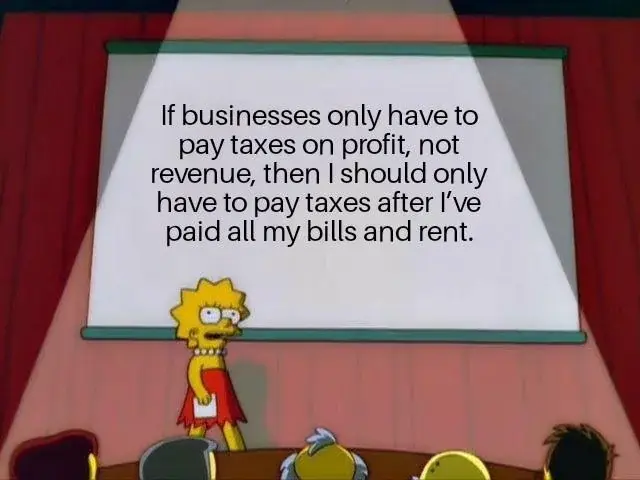
That is basically why the Standard Deduction exists.
I dunno how it works in the US but in Aus I can’t deduct anything unless it’s related to work, apparently feeding and housing myself doesn’t contribute to that …
In a lot of places a part of your income is exempt from taxes (eg brackets where you pay 0-20k @ 0%, 30-60k @ 30%, 60-100k @ 40%, 100k+ @ 50%; then your first 20k is not taxed), i think this is what they are talking about.
Edit: another possibility would be they do mean actual expenses, just reminded you can (partially) deduct education expenses from your taxes in the Netherlands.
I guess you could argue that that’s the reasoning behind the progressive tax regime. Australia’s progressive tax lines up with the low end of that but if you were going to claim that the tax free threshold was to cover general living expenses then it’s going to need to be a lot larger, 20k bere is not enough to cover rent, food and utilities here, a 3x2 near Perth is like $800/week for rent and I would argue interest on a mortgage is comparable and Perth is on the cheap end of Australian cities. That’s like 40k without utilities and food. So either the tax free threshold was poorly implemented without indexation against inflation and cost of living or the driver of it isn’t to cover basic cost of living and is more to ease the burden on the poor end of town. I guess you could say it’s a little bit of both but arguably indexation should be implemented.
Standard deduction is slightly different than an exemption. You’re deducting a set amount (instead of itemizing it, which only makes sense to do if the total is more than the standard deduction, which it won’t be for most professions).
An
exceptionexemption would be removing a portion of the taxable income before it is taxed.Pretty similar outcome for most people, but still an important distinction.
Edit: fixed autocorrect error
True, and perhaps credible for a married couple with a 31k deduction, but the 15k deduction for an individual might be a bit rough for single folks.
It’s complete bullshit. What city can you rent an apartment for 15k/year even with roommates?
Depends on what you define as a city. A quick search of a random city (Saginaw, MI), I see some 2 bedrooms for 985 a month.
Of course people from LA might not call that a city, but, to people from towns of 800 people, it is huge at about 44k people.
I’m very lucky, I rent half a house for under $10k a year in a city. But I also manage the property.
Some states allow you to deduct a portion of your property taxes, including renters (a set % of your rent). On top of the standard deduction.
From State tax, but that’s still not related to the federal deduction, where it only kicks in you itemize.
However while you may not be able to deduct your property taxes if you own a house with standard deduction, you do get to if you are a landlord regardless of standard deduction.
It doesn’t really make a difference if both parents are working and make similar amounts. Then that part is no different from filing separately.
Point is a couple shares rent. A couple’s residence is unlikely to be twice the cost of a single residence, unless you have roommates. So 30k for a couple guess further than 15k living alone.
Exactly. It’s to incentivize one person to be a bread winner and one to make less and be a home maker (or something with less hours) so you get the tax benefits. It would be a nice system if expenses weren’t so damn high.
Yeah, I don’t know any couples my age who don’t both work.
Homemaker or not, marriage promotes economic stability because of tying folks outcomes together. As an edifice, the State likes that a spouse probably steps in before aid programs or whatever.
Married couples get the same tax benefits regardless. A raise for the lower earner always means more money for the family, so no, it doesn’t incentivize having a breadwinner over having equal pay.
Hmmm…
Let’s do a quick exercise without real numbers. Please let me know if I’m wrong because this is what I thought. If I make 150k and am maxed out on my standard deduction, but then I make 250k and there’s no difference on my standard deduction, I’m not getting more standard deduction. If my wife is a stay at home mom and I make $250k, I am getting more standard deduction now, right?
This is how married taxes work, right? Am I wrong on that? We get different brackets and different rules. I’ve been marred for 7 years and my first year I got all my taxes back because she didn’t work that year. Am I wrong?
But what you’re saying: a raise for the lower earner does give more money. But by being a big earner marrying a now or low earner, it incentivizes high earners marrying low earners. Or mixed earners. It was devised in the time when women didnt work but we needed more tax benefits for taking care of women.
No. You’re correct. You would get less money back on your taxes if your wife’s income went up. However, the amount your taxes go up is less than the increase to your wife’s income, so you still end up ahead as a couple. You get the largest individual tax breaks when you have a breadwinner, but the total financial incentive (after tax returns) is for both partners to make as much money as possible.
That said, finances are very emotionally charged and how people should approach their finances depends on how they think about this stuff. That’s why snowball debt strategies work - not because they are optimal financially, but because they play into the psychology of a human paying off debt. With that in mind, I suppose you could still feel incentivized to have a large difference in incomes because of the tax breaks - it just isn’t financially optimal if there is a free opportunity for the lower earner to bring in more money.
But if I itemize instead, I can’t count those things.
Yes, and businesses do also pay taxes on more than their profits. Payroll tax is a huge one.
Payroll tax is not a tax on business, it’s also a tax on workers, it’s just business is deducting it automatically, and paying it to government, to reduce the amount of transactions.
Yes and no. You’re right of course that part of pay is withheld and paid as tax, but that isn’t what I was referring to. There is an additional component, beyond what is withheld from employee pay, which is paid directly from the business to the state which the employee never sees. It’s a similar amount.
Yeah but even that is sort of a tax on employees
When our business decides how much we can afford to pay someone for a position, the math is always with what that payroll tax is included.
So without the payroll tax we may be able to afford paying someone $25/hour.
With it we may only be able to afford to pay them $22/hour.
It reduces the amount we can afford to pay the employee, even though it’s technically never given to them in the first place it’s money that could have gone to them.
I would love to pay more but that tax takes it out of my hands.
But that doesn’t mean it’s a tax on the employee. That’s like saying sales tax is on the business, when it’s actually on the customer.
I take it that they mean that it is indirectly a tax on the employee in the sense that it is money the employee could have earned but does not because the company has to pay the tax. Could have earned as in the salary could have been higher without it.
On the otherhand, that is true for any tax a company has to pay, just not as directly releated.
(Or I could be wrong and they mean something else.)
Not really, salary and automatic tux deduction is the same line of the budget for the company, it’s money they spend directly on employer. For them there is absolutely no difference do the money come to employer or to the government, they spend X amount of money so the employer works for them, it’s the same chunk of money regardless of what percentage goes where.
That’s, like, completely the opposite of the argument. Saying that payroll tax is a tax on business is like saying sales tax is a tax on business. In both cases, the tax is paid from the money that otherwise could come to a human, it’s just business is deducting it automatically.
Sales tax is paid by the customer, not the business. I … don’t know why you think it’s automatically deducted by the business? Unless you mean B2B purchases
Do you, a person buying your whatever the fuck, then later sending a separate transfer to the government with sales tax? Or, if you’re paying cash, do you later set your sales tax for that purchase aside and send it to the government in a separate envelope?
If you must twist everything around in order to make it about the government and business screwing the employee, then you must.
I could just as easily say that the business has to pay employees more to make up for what they’re going to lose to payroll tax deductions so even the employee side tax is a tax on the business!
Or we could just be adults and admit that the government taxes the employee and the business both.