You must log in or # to comment.
That is basically why the Standard Deduction exists.
I dunno how it works in the US but in Aus I can’t deduct anything unless it’s related to work, apparently feeding and housing myself doesn’t contribute to that …
In a lot of places a part of your income is exempt from taxes (eg brackets where you pay 0-20k @ 0%, 30-60k @ 30%, 60-100k @ 40%, 100k+ @ 50%; then your first 20k is not taxed), i think this is what they are talking about.
Edit: another possibility would be they do mean actual expenses, just reminded you can (partially) deduct education expenses from your taxes in the Netherlands.
I guess you could argue that that’s the reasoning behind the progressive tax regime. Australia’s progressive tax lines up with the low end of that but if you were going to claim that the tax free threshold was to cover general living expenses then it’s going to need to be a lot larger, 20k bere is not enough to cover rent, food and utilities here, a 3x2 near Perth is like $800/week for rent and I would argue interest on a mortgage is comparable and Perth is on the cheap end of Australian cities. That’s like 40k without utilities and food. So either the tax free threshold was poorly implemented without indexation against inflation and cost of living or the driver of it isn’t to cover basic cost of living and is more to ease the burden on the poor end of town. I guess you could say it’s a little bit of both but arguably indexation should be implemented.
Standard deduction is slightly different than an exemption. You’re deducting a set amount (instead of itemizing it, which only makes sense to do if the total is more than the standard deduction, which it won’t be for most professions).
An
exceptionexemption would be removing a portion of the taxable income before it is taxed.Pretty similar outcome for most people, but still an important distinction.
Edit: fixed autocorrect error
True, and perhaps credible for a married couple with a 31k deduction, but the 15k deduction for an individual might be a bit rough for single folks.
It’s complete bullshit. What city can you rent an apartment for 15k/year even with roommates?
Depends on what you define as a city. A quick search of a random city (Saginaw, MI), I see some 2 bedrooms for 985 a month.
Of course people from LA might not call that a city, but, to people from towns of 800 people, it is huge at about 44k people.
I’m very lucky, I rent half a house for under $10k a year in a city. But I also manage the property.
Some states allow you to deduct a portion of your property taxes, including renters (a set % of your rent). On top of the standard deduction.
From State tax, but that’s still not related to the federal deduction, where it only kicks in you itemize.
However while you may not be able to deduct your property taxes if you own a house with standard deduction, you do get to if you are a landlord regardless of standard deduction.
It doesn’t really make a difference if both parents are working and make similar amounts. Then that part is no different from filing separately.
Point is a couple shares rent. A couple’s residence is unlikely to be twice the cost of a single residence, unless you have roommates. So 30k for a couple guess further than 15k living alone.
Exactly. It’s to incentivize one person to be a bread winner and one to make less and be a home maker (or something with less hours) so you get the tax benefits. It would be a nice system if expenses weren’t so damn high.
Yeah, I don’t know any couples my age who don’t both work.
Homemaker or not, marriage promotes economic stability because of tying folks outcomes together. As an edifice, the State likes that a spouse probably steps in before aid programs or whatever.
Married couples get the same tax benefits regardless. A raise for the lower earner always means more money for the family, so no, it doesn’t incentivize having a breadwinner over having equal pay.
Hmmm…
Let’s do a quick exercise without real numbers. Please let me know if I’m wrong because this is what I thought. If I make 150k and am maxed out on my standard deduction, but then I make 250k and there’s no difference on my standard deduction, I’m not getting more standard deduction. If my wife is a stay at home mom and I make $250k, I am getting more standard deduction now, right?
This is how married taxes work, right? Am I wrong on that? We get different brackets and different rules. I’ve been marred for 7 years and my first year I got all my taxes back because she didn’t work that year. Am I wrong?
But what you’re saying: a raise for the lower earner does give more money. But by being a big earner marrying a now or low earner, it incentivizes high earners marrying low earners. Or mixed earners. It was devised in the time when women didnt work but we needed more tax benefits for taking care of women.
No. You’re correct. You would get less money back on your taxes if your wife’s income went up. However, the amount your taxes go up is less than the increase to your wife’s income, so you still end up ahead as a couple. You get the largest individual tax breaks when you have a breadwinner, but the total financial incentive (after tax returns) is for both partners to make as much money as possible.
That said, finances are very emotionally charged and how people should approach their finances depends on how they think about this stuff. That’s why snowball debt strategies work - not because they are optimal financially, but because they play into the psychology of a human paying off debt. With that in mind, I suppose you could still feel incentivized to have a large difference in incomes because of the tax breaks - it just isn’t financially optimal if there is a free opportunity for the lower earner to bring in more money.
But if I itemize instead, I can’t count those things.
Yes, and businesses do also pay taxes on more than their profits. Payroll tax is a huge one.
Payroll tax is not a tax on business, it’s also a tax on workers, it’s just business is deducting it automatically, and paying it to government, to reduce the amount of transactions.
Yes and no. You’re right of course that part of pay is withheld and paid as tax, but that isn’t what I was referring to. There is an additional component, beyond what is withheld from employee pay, which is paid directly from the business to the state which the employee never sees. It’s a similar amount.
Yeah but even that is sort of a tax on employees
When our business decides how much we can afford to pay someone for a position, the math is always with what that payroll tax is included.
So without the payroll tax we may be able to afford paying someone $25/hour.
With it we may only be able to afford to pay them $22/hour.
It reduces the amount we can afford to pay the employee, even though it’s technically never given to them in the first place it’s money that could have gone to them.
I would love to pay more but that tax takes it out of my hands.
But that doesn’t mean it’s a tax on the employee. That’s like saying sales tax is on the business, when it’s actually on the customer.
I take it that they mean that it is indirectly a tax on the employee in the sense that it is money the employee could have earned but does not because the company has to pay the tax. Could have earned as in the salary could have been higher without it.
On the otherhand, that is true for any tax a company has to pay, just not as directly releated.
(Or I could be wrong and they mean something else.)
that is true for any tax a company has to pay, just not as directly releated
Not really, salary and automatic tux deduction is the same line of the budget for the company, it’s money they spend directly on employer. For them there is absolutely no difference do the money come to employer or to the government, they spend X amount of money so the employer works for them, it’s the same chunk of money regardless of what percentage goes where.
That’s, like, completely the opposite of the argument. Saying that payroll tax is a tax on business is like saying sales tax is a tax on business. In both cases, the tax is paid from the money that otherwise could come to a human, it’s just business is deducting it automatically.
In both cases, the tax is paid from the money that otherwise could come to a human, it’s just business is deducting it automatically.
Sales tax is paid by the customer, not the business. I … don’t know why you think it’s automatically deducted by the business? Unless you mean B2B purchases
If you must twist everything around in order to make it about the government and business screwing the employee, then you must.
I could just as easily say that the business has to pay employees more to make up for what they’re going to lose to payroll tax deductions so even the employee side tax is a tax on the business!
Or we could just be adults and admit that the government taxes the employee and the business both.
I wrote a free spec script for a charity organization, enabling me to write off ~$50k in charitable donations for putting in a few hours of work.
Everyone should be looking for loopholes and ways to prevent the US government from getting their money.
I asked a CPA about this idea a couple months ago and was told that it doesn’t work that way, and everything I can find on the internet backs that up. Can you provide a source saying otherwise?
I’m gonna agree with you. If OP gets audited, this will not hold up. OP cannot deduct money for a service that the charity pays nothing for. Only unreimbursed or out of pocket expenses can be deducted this way
If OP gets audited, this will not hold up.
The IRS actually already did look it over. They decided (rather arbitrarily) that the script I donated was worth ~50,000 instead of ~70,000 as I was trying to claim. Definitely not a full audit, but they already reviewed it at some level and it passed muster.
Right because you’re donating intellectual property which is property. And that distinction is fucking nonsense but here we are. I doubt a full audit would allow market prices to survive on that though. They’d be like “hey now, this didn’t cost you that.” But to do a full audit we’d actually have to fund the IRS. Good luck getting that to happen.
They’d be like “hey now, this didn’t cost you that.”
But would not that depend on how OP’s time is valued in this case? OP could argue that their expertise costs $14000/hour ($70000 over 5 hours). I am sure that they would argue the hour cost, I have not clue how the IRS handles something like this.
They don’t let you deduct the cost of your own labor ever. The property thing is the loophole (but after further research not a real loophole and they will nail you for it).
They don’t let you deduct the cost of your own labor ever.
Yes, but … if you use your own labor to create a product, and then donate the product, you can deduct the value of the product.
As I understand it, technically the “thing of value” is the script itself - because it doesn’t have a clearly defined value you can get away with claiming some fairly crazy valuations.
There’s a very similar tax loophole popular with the wealthy where you get a “great deal” on some slightly valuable art, donate it to charity, get it valued by an “expert” you know, who just happens to think it’s worth many times what you paid, then write that off on your taxes. Basically free money.
deleted by creator
Do you know if this expert has to have some kind of credentials? Or could John Smith start a non-profit, Jenny Smithy have James Smithens who is an “expert” say the value (of some object) is more than Jenny owns, have Jenny donate this object to John’s non-profit and then tax $0?
(I know it technically can be done, but do you know if there is some threshold were it will be flagged? Writing of more than you own would be a flag and call for an audit but what about something worth $1000?)
Other than my tax returns from that year? Not really.
I intend to pass the loophole my parents gave me to my children, really grateful for it
You sound like every business man ever.
You must learn from your enemy to defeat them.
This has “I….DECLARE……BANKRUPTCY!!!” vibes.
Homeowners can write off the interest paid towards their mortgage. Renters can’t write off shit.
If we have enough deductions to justify itemizing instead of taking the standard deduction.
I haven’t had a need to itemize in several years.
That’s not nearly as much of a perk as people make it out to be. It’s good for a couple of years when you’re mostly paying interest, but it’s really not much.
Remember, a deduction is just removing the expense from your taxable income. It’s not like we get that back from taxes…that’d be a credit.
So if I pay $5000 in interest over the course of the year, im not getting $5k back on my taxes. We just pretend my gross income is $5k less. And most the time, the standard deduction ends up being more anyway.
Most W2 workers take standard deduction. You aren’t missing anything.
My primary income is W2, but I have a 1099 side gig (teaching scuba and underwater photography at a university) that usually results in me itemizing mostly because my gear is stupid expensive and I rarely make an actual profit. The write-offs are enough to let me justify spending the money on the gear to help me break even while teaching.
I do multi-year write-offs on the big-ticket items, because one underwater camera rig (camera, housing, strobes, wet-lenses, etc) costs what I make teaching underwater photography across 4-6 semesters.
Aren’t business expenses normally filed under schedule C if youre a sole owner?
I think the last time I itemized was when I was doing some 1099 work, plus changed jobs, changed employment state, sold a house in one state and bought one in another.
It was a complicated tax year.
Itemizing stopped being beneficial for me when they capped the mortgage interest deduction at $10K.
It’s by design, and in theory meant to encourage ownership to put personal stakes in the region. In practice, of course, homes are laughably unaffordable and it’s a free bonus for the rich.
I was surprised to see this stat: homeownership in the US is in the mid to high 60%s range. Meaning we have twice as many owner-occupied homes as rented homes.
Now everyone please proceed to downvote this sourced fact, offered without even any commentary.
In the US maybe, not that’s not a universal thing.
You have to think about why it works that way.
A profit from a business is money that is taken out of the business. If the activities of the business generate more money than the business is spending, it doesn’t have to become profit. It can also be re-invested in hiring more people, buying more equipment, training their workforce, expanding to new locations, even given as raises or bonuses to their employees. In theory, all of the things other than generating a profit are generally things that are good for the community. Employees can get hired, or trained, or raises. The business can expand allowing more people to buy from them, etc.
A profit is taxed because it’s basically what a business does when it doesn’t have any other useful ways of spending its money. In that case the excess money is just going to the business owners. The government is basically saying "ok, well if you aren’t going to use that money for something that benefits everyone, and are just going to give it to the owners, we’ll take our cut now. If the profits go directly to the business owners as income, they’re then taxed again as income tax (again, in theory, in practice business owners don’t want to pay that as income tax so they’ll try to arrange to avoid it).
Income taxes are a different kind of taxation. They’re basically a way for the government to own part of your labour. They go back to the time when peasants worked on the land. In exchange for the soldiers protecting them from bandits, the peasants shared some of their harvest. (I realize it was much more coercive than that, but the idealized theory is that taxes were to support the government which protects you or provides you services.)
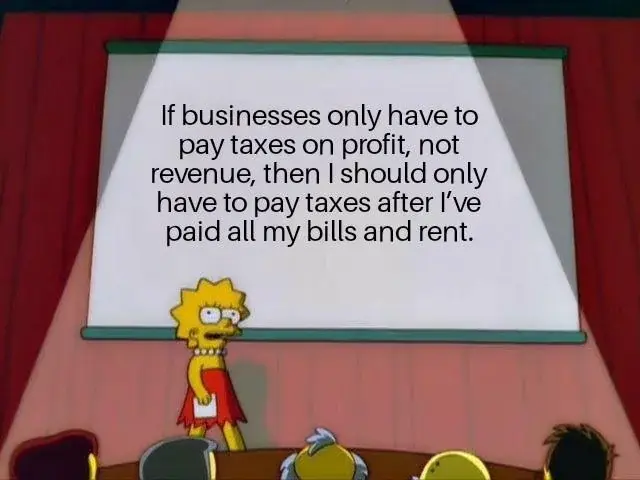
The obvious problem with “after I’ve paid all my bills and rent” is that “all my bills and rent” is something that someone could always adjust so they had to pay zero taxes. Even if you just limited it to “my housing expenses, food expenses, water bill, and electrical bill” someone might buy a huge house, or buy only the finest groceries, or install lavish fountains, or run up their electrical bills. So, instead you might want to say that someone only gets taxed after reasonable living expenses are deducted… and that’s how things work.
Progressive taxation schemes typically mean that you pay 0 tax on your first X dollars earned per year. X is supposedly set to the minimum of what someone needs to get by. The way it’s done on the US is that the lowest tax rate is set at 10%, but the standard deduction is set at $15,750, so the 10% only kicks in once you’ve passed that. $15,750 is absurdly low. It should really be at least double that, if not triple, but the idea is there. That’s the “only after I’ve paid all my bills and rent” number, if you assume someone is paying the lowest rent possible and their bills are the absolute necessities. But, I don’t think anybody could realistically live on their own for $15,750 per year.
So… yeah, Lisa. Things already work like that. It’s just that the numbers are all fucked, there are too many loopholes and exceptions.
Businesses do the exact same thing to hide their profits, espicially since the owners can now borrow money against the value of their shares instead of relying on profits.
Here’s my opinion, as someone who has zero education in economics. Feel free to voice your disagreement if you know better
If your personal expenses match your income but those expenses can’t be written off, the resulting taxes result in a net loss for that month. This would be the same with a business if expenses could not be written off
And in my opinion, buying a house should not be written off as a personal expense, and neither should a business buying a warehouse be able to write it off either. If something can be sold, only the permanent loss should be considered an expense – the remainder should be an asset
But bills and rent are generally permanent expenses. You don’t get anything back after paying them, except the continuation of your services. I think these should be deductible. Similarly, if a business has to pay for a SaaS solution, I’m okay with that being a deductible
Is my thinking flawed?
I’d say it would be nothing but a boon to the economy. Yes we’d lose a TON of tax revenue from the lower and middle class, but it would be more than made up for by the richest, who’s income is nearly entirely spending money, that they choose not to spend. (When not hidden in stocks or options or other assets).
The rich should pay more, but the rich could also hide their income by spending it – they’d also have the benefit of consultants and lawyers who could sniff out every loophole.
If the rich spent their income the global economy would be in MUCH better shape.
There aren’t as many rich people as you seem to think.
Yeah, it could possibly work if the “after bills” portion is super specific. Like rent/mortgage and utilities on primary residence Everything else is taxed. Would be hard to loophole that, but there’s a reason I’m not a lawyer.
It would be pretty easy for loopholes there. What’s a primary residence? Maybe your primary residence now contains a pub, or a co-working space, or a dance studio. Utilities are included? Well your electrical bill now supports a couple of for-profit electric car charging stations. That’s why they went with the standard deduction in the US.
So, instead you might want to say that someone only gets taxed after reasonable living expenses are deducted… and that’s how things work.
Things already work like that
Dude. What the fuck are you on?
Walmart revenue was $681 billion Walmart taxes were $6.8 billion.
Reinvestment doesn’t matter in this comparison. If it did, I could reinvest some money into something that would lower my taxable amount. That’s what the meme is about.
There got to be better examples than that. Walmart manages about 4% margin, so 653 billion went toward procuring the stuff for sale. That figure suggests a tax rate of 25%, which is low at that magnitude but not as dramatically low as other companies pull off.
And lots of Walmarts “expenses” that they take out of their profit go into property rental and acquisition, I would venture to say it’s one of if not the largest percentage of their expenses, much like my apartment is.
Dude. What the fuck are you on?
You can invest money into things that lower your taxable amount, for example charitable donations, investing in your pension and improving your home energy efficiency. That’s exactly what tax credits and itemised tax deductions are.
Where are you from?
I can file a lot of the bills for my flat (e.g. things like repairs and facility service) at the tax office, as well as stuff like child care and most of my car’s mileage (or my bike’s mileage :-) ), to be exempted from income taxing at least (there are still other taxes).
Rent money would be fully taxed, though, as well as other cost of living like food and clothing.
Country is Germany.I’ve tried writing everything off, but it’s always been less than the standard deduction.
My CPA always reminds me, US tax laws are not written for us.
Businessmen don’t get to write off their living expenses either, but feasibly you could start a business and become a contractor for your employer so you could write off things like footwear, home office square footage, and a standard deduction per mil driven between two work locations.
Best part is the
(Canadian?) IRS?CRA will never audit you unless they have the staff and they can get more out of you than the cost of the audit (roughly 20k minimum).I know a guy who started a business just to throw parties for his friends. He’d take a cover charge at the door and buy booze tax free and make sure to never turn a profit.
Got by with a banquet license which is like $8 for the night.
I knew a retired carpet cleaner who occasionally did that. He wasn’t wealthy by any means but if he was going to owe more than 3k in Taxes it was always better for him to spend it on a “business trip”.
home office square footage
Can you not do that as an employee in Canada?
In Australia employees who work from home can either calculate all your actual work from home expenses and deduct that, or use the standard fixed rate (which varies by year, but last financial year was 70 c per hour) which includes utilities and stationary/consumables. With the fixed rate you can still additionally deduct depreciating assets like computers and furniture (proportional to how often they are actually used for work).
If you work from home in the US you can deduct for a dedicated home office. I did it but it didn’t save me a penny tax wise. Not sure if my office is to small or my income to low.
The problem is that in the US, most tax deductions are concurrent with the standard deduction. So even if (for example) you donate $10k to a charity, the fact that it’s tax deductible is meaningless unless your total deductions are more than $16,100 (or more if married or head of household). It’s yet another way that tax deductions favor the rich - past a certain tax bracket, it makes sense to donate to a charity (that you control) to lower your taxes; for random Joe Peasant, it’s completely pointless.
tbh I’m not sure, I’ve never attempted it in Canada. Works that way in the US.
I believe you can deduct up to 30% of your rental costs, depending on square footage dedicated to office space in Canada.
In the US that’s usually a bad deal because you lose employer-sponsored healthcare.
That’s how it works in many countries.
Business pays tax on profits (revenue - expenses). Salary has smaller tax for business compared to pure profits, employees don’t pay it because it’s not profit. So businesses have incentives to keep human employees instead of keeping all the profits for themselves.
And that applies to all businesses. So if you, for example, bought a carrot for $10, tax is included, you don’t pay tax on it.
- The distributor bought it for $6, spent $1, pays tax on their profit ($3),
- farmer grew it, used fertilizer, seeds, labor, etc., pays tax on profit (maybe $2),
- the fertilizer company again pays tax on their profit, and so on
In US you pay tax on every transaction. You get salary, you pay tax, you buy a thing, you pay tax, you eat something, again tax. This makes you more aware government is taking money, compared to the first scenario. But it also gives government ways to make complicated rules and give different tax benefits to different people. In the first scenario, government help goes to everyone whether they have a job or not. In this case you only get Tax cuts if you already make money.
This is the first time I hear that there are countries that have company profit tax more than employee tax. What countries are those?
Interesting, I thought that’d be a normal thing because it makes so much sense.
I didn’t go deeper into it, but I could see several examples in just the first 10 entries here:
https://en.wikipedia.org/wiki/List_of_countries_by_tax_rates
The corporate tax rate starts from high amount, while individual starts from lower amount, and in many case even the top earners don’t have as high. It’s mostly because top earners are still salaried and that’s not “profit”, if you have a business you already are paying corporate tax. Many rich people employ their family to pay less tax, but you can’t do anything that requires specific qualifications.
Edit: for individual tax brackets and what is a reasonable salary, would take more research. I might do that later in the month because now I’m interested.
Progressive taxes are kind of supposed to take into account basic necessities and tax you more on estimated expendable income. So if you earn more, you can pay a higher portion of what you earn.
But also, I agree. Especially with cost of living being radically different depending on where you live. House, car, utilities, and grocery should all be deductible.
And the progressive tax on workers is way higher than on business.
Makes more sense than it might seem, since when you pay all those bills, that’s usually taxable income to the recipient. So if it isn’t a write off, taxes can be paid many times on the same item.
Things you buy for work are also tax deductible, it’s more noticeable for businesses since they don’t generally make employees pay business expenses.
That’s kind of what the standard deduction is. Horribly out of date and not on pace with inflation, but still.
Even then a whole lot of people wouldn’t get as much as the standard.
If corporations are people now then why do the get away with not paying the federal income tax?
If corporations are people why is it legal for them to buy and dissolve each other?
Should make myself a business and right off everything as reinvesting in my life.
Surely businesses’ investments can’t be written off? If they could, that would be a massive flaw in the system
They can, and I think it makes a lot of sense.
Lets say you start a lawncare business and buy a lawnmower for $1000. You don’t manage to get that many customers the first year, and only make exactly $1000. You haven’t lost money, but didn’t make any profit either.
Should you now have to pay tax on those $1000 dollars of revenue, causing you to have lost money despite your hard work? Where would you even get that money from to pay the tax?
I think the problem is not the basic system, but that the rules are too complex and have loopholes that allow you to pay less tax if you are an expert on the rules - or have enough money that it’s worth it to hire one.
Well you still have the lawn mower, which you can sell. But you’ll get less than you paid for it (you might get $400) – and I think that difference ($600) is the only part that should be exempt from taxes